
Class-Specific Protein Assay Kits


Cell Biolabs Inc Beta-Hexosaminidase Assay Kit, 100 assays
Hexosaminidase is an enzyme that hydrolyzes terminal N-acetyl-D-hexosamine residues from N-acetyl-ß-D-hexosaminidines. The enzyme is typically found as a dimer of the alpha and beta subunits. Cell Biolabs' Beta Hexosaminidase Assay Kit quantifies the activity of the beta subunit in a convenient 96-well microplate format. Each kit provides sufficient reagents for 100 assays including standards and unknown samples.

Bio Rad Laboratories BIORAD DC PROTEIN ASSAY KIT II
Detergent-compatible colorimetric assay kit, includes 250 ml alkaline copper tartrate, 2 L dilute Folin reagent, 5 ml surfactant solution, BSA standard; 450 assays

AnaSpec SENSOLYTE 520 TEV ACTIVITY KIT
SensoLyte 520 TEV Activity Assay Kit *Fluorimetric*, (1 kit) Tobacco Etch Virus (TEV) proteinase is widely used to remove fusion tags from recombinant proteins. It recognizes specific sequence Glu-Asn-Leu-Tyr-Phe-Gln-Gly and cleaves between Glutamine and Glycine residues. TEV protease is active even at 4 Deg.C, making it the protease of choice for fusion proteins or tags removal. The SensoLyte TEV Protease Assay Kit uses TEV specific Glu-Asn-Leu-Tyr-Phe-Gln-Gly substrate labeled with 5-FAM dye and QXL 520 quencher. Proteolytic cleavage of this quenched 5-FAM-QXL 520 conjugate yields a brightly green fluorescence, which can be continuously monitored at Ex/Em= 490/520 nm. Increase in fluorescence intensity is directly proportional to the TEV protease quantity/activity.
Sigma Aldrich Fine Chemicals Biosciences Human DNA quantitation standard NIST(R) SRM(R) 2372a |
Human DNA quantitation standard NIST(R) SRM(R) 2372a |
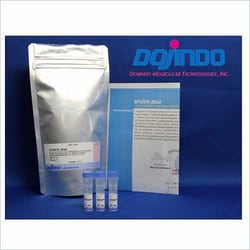
Dojindo Molecular Technologies Inc SPiDER-gal (20UG x3) is a fluorogenic beta-galactosidase detection probe applicable for living cells and tissues.
The gene of β -galactosidase from E. coli is widely used as a reporter gene assay marker. Although X-gal is a well known reagent to detect β -galactosidase in cell or tissue samples, the assay using these reagents require to fix cells or tissues due to the poor cell-permeability. In addition, the assay using fluorescence reagents can not clearly differentiate β -galactosidase - expressed cells or regions in its current development. SPiDER-Gal ideally possesses cell-permeability and the ability to retain in the intracellular region. With the enzymatic reaction, SPiDER-Gal immediately forms a quinone methide that acts as electrophile when proteins containing nucleophilic functional groups are nearby the molecules. When the probe undergoes the reaction with a protein, the conjugates become fluorescent compounds. SPiDER-βGal allows a single-cell analysis because it self-immobilizes to the intracellular proteins.
TOPOGEN INC Topoisomerase I Assay Kit 100 Assays Includes Top1
This kit contains reagents for routine detection of type I topoisomerase activity. DNA markers (included) allow unequivocal detection of the enzyme. The assay is specific for topoisomerase I; (eukaryotic type II topoisomerases require MgCl2 and ATP). The standard topo I assay kit is supplied with EDTA containing reaction buffer (minus Mg++) in order to prevent nucleolytic nicking of the supercoiled substrate (although we note that some eukaryotic type I activities are stimulated by Mg++). This assay will work even with crude extracts.
AMERICAN RESEARCH PRODUCTS INC NADP-MALATE DEHYDROGENASE KIT
503029956 NADP-MALATE DEHYDROGENASE KIT
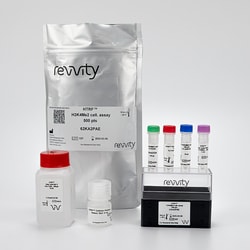
Revvity Health Sciences Inc HTRF EPIgeneous 2-methyl K4 Histone H3 Detection Kit, 500 Assay Points
HTRF EPIgeneous 2-methyl K4 Histone H3 Detection Kit, 500 Assay Points
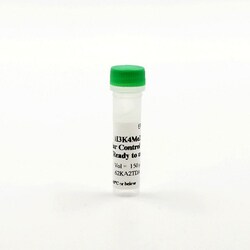
Revvity Health Sciences Inc HTRF EPIgeneous 2-methyl K4 Histone H3 Detection Kit, Control Lysate
HTRF EPIgeneous 2-methyl K4 Histone H3 Detection Kit, Control Lysate
Sigma Aldrich Fine Chemicals Biosciences Succinate Dehydrogenase Assay Kit
Succinate Dehydrogenase Assay Kitsufficient for 100 colorimetric tests
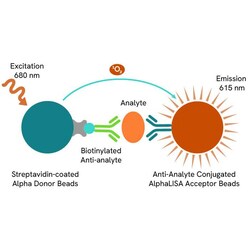
Revvity Health Sciences Inc AlphaLISA Host Cell Residual DNA Detection Kit, 5,000 Assay Points
AlphaLISA Host Cell Residual DNA Detection Kit, 5,000 Assay Points
Bioworld BIOTRAP SERUM ABUNDANT PROT
BIOTRAP SERUM ABUNDANT PROTEIN REMOVAL KIT (MIXTURE OF ANTIBODIES): biotRAP Serum Abundant Protein Removal Kit bio-WORLD's biotRAP Serum Abundant Protein Removal kit removes four highly abundant proteins from human serum and plasma. Th...